
To read a peptide certificate of analysis (COA), check five things in order. First, the lab name and report number. Second, a batch number that matches your vial. Third, HPLC purity, with its method. Fourth, mass spectrometry, which confirms identity. Fifth, net peptide content, which shows how much of the powder is actually peptide. Then verify the report with the lab that issued it.
A COA can look confusing the first time you open one, with percentages, graphs and long reference numbers. The good news is that almost every COA follows the same simple pattern. This guide walks through each part in plain English, from the batch number to HPLC purity and mass spectrometry, and shows how to tell whether a report can be trusted. It is written for researchers and labs in the UK and elsewhere.
Educational content only. All materials discussed here are for in vitro laboratory research use only and are not intended for human or veterinary use.
What Is a Peptide Certificate of Analysis (COA)?
A peptide certificate of analysis (COA) is a lab report that records the test results for one specific batch of a peptide. It shows what sample was tested, which methods were used and what they found. It also links the results to a batch number, so you can match the report to the vial you received.
For researchers, the COA is the main way to check that the material is the compound on the label and that it is as pure as the supplier says. This matters because a wrong compound, or one with many impurities, can spoil an experiment without any obvious sign.
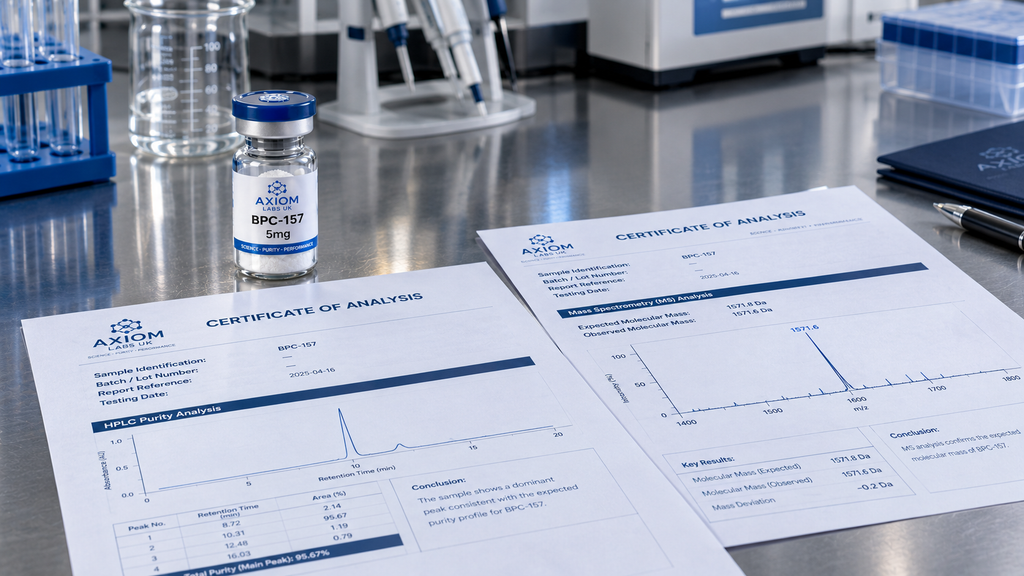
The Three Questions Every COA Answers: Purity, Identity and Quantity
Almost every peptide COA is built to answer three questions. Keeping them apart makes the report much easier to read, because a different test answers each one.
• Purity: how much of what was detected is the target peptide, rather than related impurities? HPLC answers this.
• Identity: is this the right molecule? Mass spectrometry answers this.
• Quantity: how much peptide is actually in the vial? A net peptide content test answers this, and it is not the same thing as purity.
If a report covers only one or two of these, the others are left open.
Anatomy of a Peptide COA: A Section-by-Section Walkthrough
Labs format their reports in different ways, but a peptide COA nearly always has the same building blocks: who tested the sample, what the sample was, which batch it came from, when it was tested and what the tests found. The table below lists each field and what to look for. The test results themselves (mass spectrometry, HPLC and content) are explained in their own sections further down.
| # | Field | What it tells you | What to check |
| 1 | Lab name and contact details | Who did the testing | A named lab you can contact, not just the seller’s letterhead |
| 2 | Report or task number, verification key | The unique reference for this test | That the number is shown and can be traced to the lab |
| 3 | Sample name and sequence | The compound the sender declared | That it matches the product |
| 4 | Batch or lot number | The production run the sample belongs to | That it matches the number on your vial |
| 5 | Declared amount | The quantity stated for the sample | That it fits the product label |
| 6 | Dates received and analysed | When the work was done | That dates are shown and make sense |
| 7 | Appearance | The physical form of the material | A clear description, such as white lyophilised powder |
| 8 | Results and method notes | Identity, purity and content, and how each was measured | That every result names its method |
| 9 | Authorisation | Who approved the report | A signature, stamp or electronic approval |
The Header: Laboratory, Report Number and Sample Details
The top of the report shows who stands behind the data. Look for the lab’s name and contact details, a report or task number and, on many reports, a verification key that lets you look the result up at the source. Below that is the sample description: the peptide name, often its amino acid sequence in one-letter code, and the amount that was declared.
The sample description is what the person who sent the sample told the lab. The lab reports what it measured in that sample. It does not prove where the sample came from. That is why the batch number, covered next, matters so much.
Batch or Lot Number: Matching the COA to Your Vial
A batch number (also called a lot number) names one production run. It is the link between the lab’s data and the vial in your hands. Find the number on the report, then compare it, character by character, with the number on your vial label, packaging or order paperwork.
A COA belongs to the batch it names and to no other. If the number is missing or does not match, the report is not evidence about your material.
Dates: When Was the Sample Received and Analysed?
Most reports show a date received and a date analysed. These tell you how recent the data is. A result does not expire on a set day, but a report dated well before the batch was made makes no sense, and a very old report tells you less about the material in front of you today. If a report has no dates at all, ask about it before you rely on it.
The Appearance Field: What “White Lyophilised Powder” Tells You
Appearance is the simplest line on the report. A common entry is “white to off-white lyophilised powder”. Lyophilised means freeze-dried, which is the usual form for research peptides. The entry describes the sample at the time of testing and gives you a quick visual check when a vial arrives.
Appearance is a description, not a measurement. The colour or texture of a powder cannot prove purity or identity, so use it only as a basic consistency check next to the test results.
HPLC Purity: What the Percentage Really Means
HPLC purity is the share of the detected signal that comes from the main peptide, shown as a percentage. A result of 98.4% means that, under the stated method, 98.4% of what the detector picked up was the target peptide. The other 1.6% came from related substances.
This number does not tell you how much peptide is in the vial. That is covered in the section on net peptide content.
How HPLC Separates and Measures a Peptide
High-performance liquid chromatography (HPLC) pushes a dissolved sample through a column under pressure. Each part of the sample leaves the column at a different time, depending on how strongly it sticks to the column.
As each part comes out, a detector records it as a peak. For peptides, the detector is usually set to UV light at about 214 to 220 nm, where peptide bonds absorb.
Purity is then worked out from the peak areas:
Purity (%) = main peak area ÷ total area of all peaks × 100
The method matters as much as the number. The same sample can give slightly different results with a different column, gradient or wavelength. A purity value only means something when you know the conditions used to get it, so look for a method statement, even a short one.
Reading the Chromatogram: Peaks, Retention Time and Baseline
The chromatogram is the graph behind the percentage, and it often tells you more than the number. Four things are worth a quick look:
• A clear main peak. In a well-separated sample, one large peak stands apart from the rest.
• Small peaks beside it. These are usually by-products of synthesis, such as shortened versions of the peptide or versions with an amino acid missing. A few small peaks are normal. Together they make up the remaining percentage.
• Retention time. This is the time at which the main peak appears. It should be stated, and it should be steady for the same method.
• A flat, steady baseline. A noisy or drifting baseline makes small peaks harder to measure.
If a report gives only a percentage and no chromatogram, you are relying on a summary you cannot check.
How High Should HPLC Purity Be for Research Peptides?
No single number suits every experiment. The right level depends on how the material will be used. A sensitive cell-based test usually needs tighter control of impurities than a routine reference use. In practice, research peptides are often supplied with purities in the high nineties, and many suppliers state a minimum of 98% or more.
A higher number means fewer detected impurities under that method. It does not mean a perfect sample.
Mass Spectrometry: Confirming a Peptide Is What It Claims to Be
Mass spectrometry (MS) is the test that confirms a peptide’s identity. It measures the molecular mass of the main component in the sample, and the report compares that observed mass with the theoretical mass worked out from the peptide’s sequence. A close match supports the claim that the material is the compound named on the label.
This is the step HPLC cannot do. A chromatogram shows how many components a sample has and in what amounts, but a single clean peak can belong to the wrong molecule just as easily as the right one.
Expected vs Observed Mass: How the Match Works
The expected mass is worked out by adding up the masses of the amino acids in the sequence, plus one water molecule for the two ends of the chain. The observed mass is what the instrument actually measured. The two should agree within the tolerance of the method. Mass is measured in daltons (Da).
Two details help you read this line correctly:
• Monoisotopic or average mass. These are two ways to calculate mass. They differ slightly, so a good report says which one it uses.
• Tolerance. The observed mass should be very close to the expected mass. Better instruments agree more closely. What matters is that the report shows both numbers.
It also helps to know what a match does not prove. It shows that a component of the expected mass is present. It cannot tell apart two peptides that have the same mass but a different sequence. Confirming the sequence needs a further test called MS/MS.
Small extra peaks are common and usually easy to explain. A peak about 16 Da above the main mass often points to oxidation. A peak about 22 Da higher than the main ion is often a sodium adduct, where a sodium ion has taken the place of a hydrogen.
Why the Number May Look Different: Charge States and m/z Explained
A mass spectrometer does not measure mass directly. It measures the mass-to-charge ratio (m/z) of ions. With electrospray ionisation, the most common method for peptides, one molecule can pick up more than one proton. So the same peptide shows up at several m/z values at once, one for each charge state.
The relationship is simple:
m/z = (M + n × 1.007) ÷ n
Here M is the molecular mass and n is the number of protons gained. The table shows an illustrative peptide with a mass of 1,500 Da.
| Charge state | Ion | Expected m/z |
| 1+ | [M+H]⁺ | about 1,501.0 |
| 2+ | [M+2H]²⁺ | about 751.0 |
| 3+ | [M+3H]³⁺ | about 501.0 |
So a spectrum with strong peaks at 751.0 and 501.0 is not a mismatch for a 1,500 Da peptide. It is exactly what that peptide should look like. Many reports use software to turn these peaks into one neutral mass (called deconvolution), and that converted value is the one to compare with the expected mass.
When you read an MS result, check that the labelled peaks agree with each other, meaning they all point to the same molecular mass through different charge states, and that the mass the report quotes follows from them.
Purity vs Net Peptide Content: Why 99% Pure Doesn’t Mean 99% of the Vial
HPLC purity and net peptide content (NPC) measure two different things. Purity tells you what share of the detected peptide material is the target peptide. Net peptide content tells you what share of the powder’s weight is peptide at all. A vial can show 99% HPLC purity and still hold clearly less than 99% peptide by weight, because the rest of the powder is water and counter-ions, and neither counts as an impurity in an HPLC purity figure.
What Else Is in the Powder: Counter-Ions and Water
A freeze-dried peptide is rarely 100% peptide. Two things account for most of the difference.
• Counter-ions. Peptides are made and cleaned with acids. Parts of the peptide carry a positive charge, and they hold on to matching negative ions. The result is a salt, most often a TFA or acetate salt.
• Water. Freeze-dried peptides take up moisture from the air. It is often measured by Karl Fischer titration.
Neither shows up as an impurity in HPLC, so purity alone cannot tell you how much peptide you have. Net peptide content does. It is usually measured by amino acid analysis and reported as a percentage of the powder’s weight. It varies between peptides and batches, so use the figure from your own report.
A stated amount such as “5 mg” may mean the total weight of powder in the vial, or it may mean the peptide content only. The COA should make clear which one is used.
A Worked Example: From Gross Weight to Actual Peptide
Here is how the numbers fit together. The figures below are for illustration only and do not come from any real batch.
| Quantity | Value |
| Total weight of powder in the vial | 5.00 mg |
| Net peptide content (NPC) | 80% |
| HPLC purity | 98% |
| Molecular weight of the peptide | 1,500 g/mol |
1. Peptide material in the vial: 5.00 mg × 0.80 = 4.00 mg
2. Target peptide within that material: 4.00 mg × 0.98 = 3.92 mg
3. Amount in moles: 3.92 mg ÷ 1,500 g/mol = 0.00261 mmol, or about 2.61 µmol
So in this example, a 5 mg vial holds about 3.9 mg of the target peptide. That is the figure that matters when you need to work out a molar amount, for example when making a solution of a set concentration for an in vitro experiment.
This method assumes the NPC on the report covers all peptide material, which is the usual rule, so check how your COA defines it. If a report gives no content result at all, you cannot do this calculation reliably, and that gap is worth raising before the material is used.
Other Tests You May See on a COA
Beyond identity, purity and content, some COAs include extra tests: endotoxin, sterility or microbial counts, heavy metals and residual solvents. Which ones appear depends on what was asked for when the sample was sent to the lab, so a report only tells you about the properties it actually lists. If a test is not on the report, treat that property as untested. Do not assume it passed.
| Test | Usual method | Question it answers | What it doesn’t tell you |
| Endotoxin | LAL assay | Are bacterial endotoxins present, and at what level? | Whether living microorganisms are present |
| Sterility or microbial count | Culture-based testing | Are living microorganisms detected? | The endotoxin level |
| Heavy metals | ICP-MS | Are trace metals such as lead or arsenic present? | Organic impurities or peptide purity |
| Residual solvents | Headspace gas chromatography | Are solvents from making the peptide still present? | Metal contamination |
Water content is covered in the net peptide content section above, so the two parts below cover the rest.
Endotoxin and Sterility
Endotoxins are pieces of the outer wall of certain bacteria. They can stay in a sample even when no living bacteria are left, and they can cause strong reactions in cell-based experiments, especially with immune cells. They are measured with the LAL (Limulus amebocyte lysate) assay and reported in endotoxin units (EU) per millilitre or per milligram.
Sterility and microbial testing ask a different question: are living microorganisms present? The two results are independent. A sample can pass one and fail the other, so a report that shows only one of them does not cover both.
Two practical points apply here:
• Freeze-drying does not sterilise a peptide. It is a way to preserve material, so do not assume a powder is sterile from its look or form.
• Limits depend on the use. Cell culture work usually needs tighter control than a chemical reference use. A good report states the limit it was compared against, so you can judge the result against your own needs.
Heavy Metals and Residual Solvents
Heavy metals are usually checked by ICP-MS (inductively coupled plasma mass spectrometry), which finds trace elements at very low levels. The elements most often reported are arsenic, cadmium, lead and mercury. Look for a result for each element, with units (such as µg/g or ppm) and the limit used.
The wording of a result matters. “Not detected” means the level was below the method’s detection limit, which is not the same as zero. Some reports say “below the limit of quantification”, which means a trace may be present but is too small to measure exactly.
Residual solvents are what is left over from making and cleaning the peptide. Common examples are acetonitrile and DMF. They are usually measured by gas chromatography, and the report should list each solvent with its result.
Drug-quality guidelines are often used as a reference: ICH Q3C for residual solvents and ICH Q3D for metals. Research-grade material is not always held to them, so a good report states which limits it used.
Red Flags on a Peptide COA: Signs of an Edited or Fake Report
Red flags are problems you can spot on the report itself, before you do any outside checks. One red flag does not prove that a report is fake. It is a good reason to ask questions before you rely on the data.
Missing Information
Be careful if you see any of these gaps:
• No batch number, or a batch number that does not match your vial
• No named lab you can contact, only the seller’s own letterhead
• No mass spectrometry result, so identity has not been confirmed
• A purity figure with no method and no chromatogram
Suspicious Details
Some problems sit in the details rather than the gaps:
• A purity of exactly 100%, which is very rare in real data
• Numbers that look too neat, such as round figures all the way through
• A sample name or amount that does not match the product you bought
• Fonts, logos or spacing that look uneven, or headers that look cut off, which can suggest an edited document
How to Check a COA Is Genuine
A COA can look perfect and still not be genuine, so some checks have to happen outside the page itself. These four steps cover the most important ones.
Verify the Report Number on the Laboratory’s Own Website
Many independent labs let anyone look up a report online using the report number and a verification key. If the lab named on your COA offers this, use it.
1. Type the lab’s web address into your browser yourself. Do not use a link printed on the report or sent by the seller.
2. Enter the report number and key.
3. Compare what comes up with your copy of the report: the compound name, the results, the date and the batch number.
If the online record shows a different compound, different results or a different date, treat the report as unreliable. If the lab has no online check, you can email it with the report number and ask it to confirm that it issued the report.
Check the Laboratory: Independent and Accredited
Independent means the lab has no ownership or money link with the seller. A lab that serves many clients has less reason to favour any one of them than a lab that tests for a single company.
Accreditation adds another layer. Many labs follow ISO/IEC 17025, the international standard for testing labs. In the UK, the national accreditation body is UKAS.
Accreditation covers specific tests, so check that the tests on your report are included. A lab without accreditation is not automatically poor, and an accredited lab does not guarantee every sample was handled well. Treat it as one piece of evidence, not proof.
Spotting a Reused or Recycled Report
Real batches are never exactly the same. Each time a peptide is made and tested, small differences appear. If you have more than one report, watch for these signs of reuse:
• Chromatogram traces that look identical down to every small bump, for different batches
• Traces that look the same for different compounds
• The same purity and mass values across many batches
• The same dates, report number or layout details on reports for different products
Put the reports side by side. Natural variation is a good sign. Perfect repetition is not.
If Something Doesn’t Match: What to Ask the Supplier (Email Template)
If a number does not match or a section is missing, ask the supplier in clear, polite terms. A reliable supplier should be able to answer. You can adapt this template:
Subject: Request for batch-specific COA – [Product name], batch [number]
Hello,
I received
• The name of the testing laboratory and the report number
• Identity by mass spectrometry (observed and expected mass)
• Purity by HPLC, with the chromatogram
• A net peptide content result, if it was tested
• The date of analysis
[If relevant: The batch number on the COA I was given is [number], which does not match my vial. Please confirm which report applies to my batch.]
Thank you,
[Your name]
Keep a copy of the reply. If the supplier cannot provide matching documentation, it is sensible to hold off using the material until the question is settled.
What a COA Can’t Tell You
A COA cannot tell you:
• Anything beyond the sample that was tested. The results describe that sample on the day it was tested. The link to your vial rests on the batch number and the lab’s records.
• What happened after testing. Storage, shipping and handling can all change a material over time, and a COA cannot show this.
• Whether the material suits a particular use. A COA reports analysis. It is not a statement about safety or fitness for any purpose, and the materials discussed in this guide are for laboratory research only.
• How the peptide will behave in your own experiment. Good analytical data lowers risk, but it does not replace your own controls.
Peptide COA Checklist
Use this list when a new COA arrives. Tick each item, and ask the supplier about anything you cannot tick.
☐ Lab name and contact details are shown
☐ Report number is present and can be checked on the lab’s own website
☐ Batch number matches my vial
☐ Sample name and amount match the product
☐ Dates are shown and make sense
☐ HPLC purity is shown with a method, and ideally the chromatogram
☐ Mass spectrometry shows observed and expected mass, and they agree
☐ Net peptide content is reported, or I know it is missing
☐ Any other tests I need (endotoxin, sterility, metals, solvents) are on the report, with limits
☐ Nothing looks edited, reused or too perfect
Tip: keep a copy of each COA with your batch records, so you can trace every experiment back to the report behind it.
Frequently Asked Questions
What Is the Difference Between a COA, a Spec Sheet and an SDS?
They answer three different questions. A COA gives the test results for one specific batch. A specification sheet lists the targets a product is meant to meet, such as a minimum purity. A safety data sheet (SDS) explains handling, storage and hazard information.
HPLC vs UPLC vs LC-MS: What Do These Terms Mean on a Report?
HPLC is the standard purity method described earlier. UPLC is a faster, higher-pressure version of HPLC that uses finer column particles, which often gives sharper peaks. LC-MS joins a liquid chromatography step to a mass spectrometer, so one run can give both a purity profile and the mass of each component. Reports may use any of these terms, so check that the method named covers both purity and identity.
Why Might Two Laboratories Report Different Purity for the Same Peptide?
Small differences are normal. Labs may use different columns, gradients, detection wavelengths or settings for measuring peak areas, and the sample may have been stored or prepared differently. A gap of a fraction of a percent is usually not a concern. A large gap is worth a question, starting with the method details from each report.
What Does “TFA Salt” or “Acetate Salt” Mean on a Peptide Label?
A salt name on a label tells you which counter-ion is bound to the peptide. TFA (trifluoroacetate) salts come from the acids used when the peptide is cleaned up. Acetate salts are made by swapping the TFA for acetate. The counter-ion adds weight to the powder, so it affects net peptide content, and TFA can interfere with some cell-based experiments. If this matters for your work, check which salt form your label or COA states.
Final Thoughts: Reading a COA With Confidence
A COA is easy to read once you take it in order, and the checks above take only a few minutes.
At Axiom Labs UK, we believe quality begins with transparency. Whichever supplier you choose, ask for a batch-specific COA before you start work.
To keep learning, read our guide to Semax vs Selank research, which shows how to judge the strength of evidence in early studies. You can also browse our research peptides or contact our team if you have questions.
All materials discussed in this article are for in vitro laboratory research use only. They are not intended for human or veterinary use.